

Moving goods across borders is not a single transport choice. International freight transport moves cargo between countries by air, sea, road, rail, or a combination of modes, linking suppliers, ports, airports, and destinations. The right option depends on the shipment’s urgency, volume, and route.
For businesses, choosing a mode means balancing delivery timing, cargo requirements, and the demands of international trade. Ocean shipping often suits larger, less urgent shipments, while air freight can serve time-sensitive cargo. Neither works in isolation: route planning, cargo handling, and customs documentation also shape a shipment’s journey.
This overview explains what international freight transport involves and how ocean and air shipping support global trade. You’ll learn the practical differences between these modes, when each may fit, and which shipment details influence the choice. It’s a starting point for understanding how goods move across borders with coordinated planning.
Key Takeaways
- Trace how multimodal and door-to-door shipping can connect each stage of a cross-border journey.
- Compare full-container, less-than-container-load, and breakbulk shipping to identify which ocean option best fits a shipment.
- Weigh speed, cargo needs, and route capacity when deciding whether air freight is suitable.
- Understand how coordinated freight movement supports trade between countries and keeps goods moving through supply chains.
What Is International Freight Transport?
Freight moving between countries can travel by air, sea, road, rail, or a combination of modes. A route links cargo origins, transport hubs, border processes, and final destinations.
Multimodal and Door-to-Door Freight
Multimodal freight combines transport modes, while door-to-door shipping moves cargo from origin to destination on the same equipment. This can reduce transfers, interim storage, and separate handling arrangements. Land freight links factories, warehouses, ports, and airports, supporting first-mile and last-mile connections. Planning depends on cargo weight, dimensions, commodity type, Incoterms, origin, destination, and urgency.
International Shipping Methods
Ocean freight suits larger, less urgent shipments; air freight is typically faster and more costly. Road and rail connect inland locations with ports, airports, and destinations, either on their own or alongside another mode. Choose based on the cargo, route, volume, and urgency. For international freight transport, assess a forwarder’s cargo evaluation, mode recommendations, booking coordination, document management, and customs support.
Freight Planning and Shipment Tracking
International freight transport planning starts with cargo details, origin, destination, and delivery priorities. Next, select a route and mode, arrange bookings, prepare documents, and coordinate handling and customs. Tracking provides visibility across shipment stages. Transit time depends on the mode, route, destination, and disruptions such as port congestion, weather, inspections, or inland delays. Incoterms allocate responsibilities, costs, and risk between trading parties.
Shipping Documents and Customs Requirements
Common shipment documents include a commercial invoice, packing list, and transport document, as well as any permits or certificates required for export or import. For U.S. imports, clearance depends on product classification, declared value, origin, permits, duties, taxes, and restricted-goods rules. Clearance may take place at origin, destination, or both. In international freight transport, accurate documents and shipment details help prevent avoidable processing delays. Insurance coverage and liability depend on policy terms and transport arrangements.
Ocean freight, including full-container, LCL, and breakbulk shipping
Ocean freight moves cargo by vessel between ports, with inland transport connecting those ports to shipment origins and destinations. The shipment type and container fit shape the booking and handling plan.
Ocean Freight Shipment Types
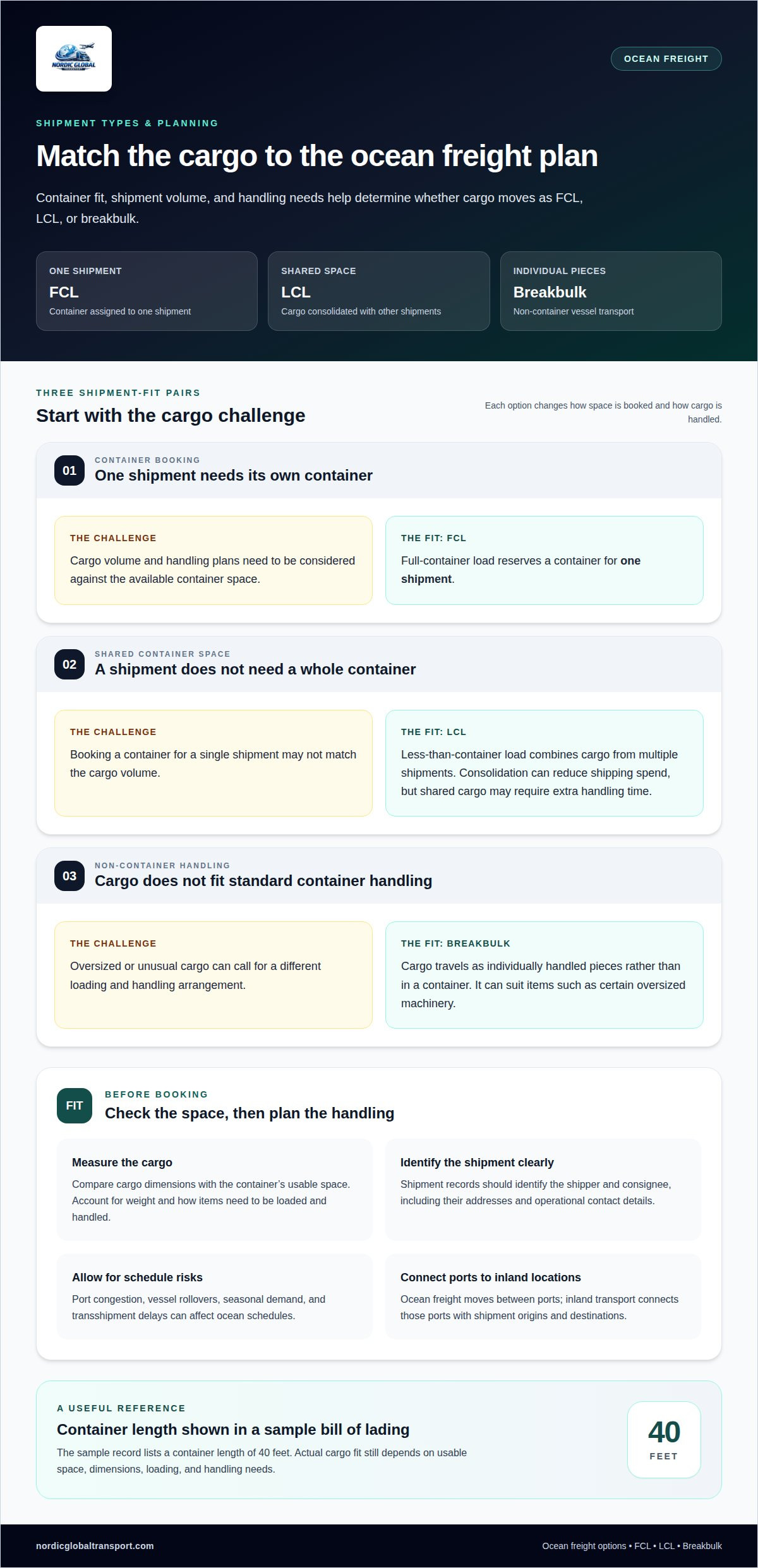
Full-container load (FCL) reserves a container for one shipment, while less-than-container load (LCL) combines cargo from multiple shipments. These options help businesses match cargo volume to a suitable shipping arrangement. LCL consolidation can reduce shipping spend, but shared cargo may require extra handling time.
Breakbulk shipping carries cargo as individual pieces rather than in a container. It can suit items that do not fit standard container handling, such as certain oversized machinery. Cargo dimensions, weight, and handling needs guide the plan. Port congestion, vessel rollovers, seasonal demand, and transshipment delays can affect ocean schedules.
Container Dimensions and Service Types
Container dimensions describe the space available for cargo, while service type determines how that space is used. A sample bill of lading lists a container length of 40 feet. Compare cargo dimensions with the container’s usable space, and account for how items must be loaded and handled.
With LCL, cargo from multiple shipments shares container space; FCL assigns a container to one shipment. Breakbulk uses non-container vessel transport for individually handled cargo. A sample bill of lading also identifies the mode as vessel, non-container. These distinctions clarify handling and transport arrangements before booking.
Shipment records should clearly identify the shipper and consignee, including their addresses and operational contact details. For cargo suited to ocean movement, sea freight planning options can help align the service with shipment volume and handling needs.
NORDIC GLOBAL TRANSPORT offers full-container, LCL, and breakbulk ocean freight services to major ports worldwide. Ocean freight is generally an economical option for larger volumes and non-urgent cargo, although transit times are slower. It can be a practical fit when shipment volume and timing align, while the final choice still depends on cargo and handling needs.
Cargo such as oversized machinery, vehicles, dangerous goods, and fragile items usually require additional handling and pricing in international freight transport. NORDIC GLOBAL TRANSPORT’s listed physical address is 88 South Ave, Fanwood, New Jersey 07023, and its listed phone number is (908) 490-1020.
Air freight
Air freight moves cargo by aircraft and is often selected for time-sensitive or high-value shipments. It is typically the fastest option for long-distance freight, but also the most expensive. The first air freight shipment was delivered in 1910, marking an early use of aircraft for moving goods. Today, shipment planning weighs urgency against cargo size, destination, and transport budget.
Air cargo suits shipments where timing has particular commercial importance. For example, a business facing a production shortage may prioritize getting a replacement component to its destination quickly. High-value goods may also benefit from a shorter transport journey. Air service still depends on route capacity, carrier demand, and seasonality, so account for these factors from the start.
Both volume and weight matter. Air freight rates may use chargeable weight, while ocean rates may depend on container size or cubic measurement. Cargo dimensions can therefore affect how a shipment is assessed, alongside its actual weight. Provide accurate measurements and shipment details when arranging freight so the planned transport reflects the cargo being booked.
Freight forwarding connects the air booking to the rest of the shipment plan. A forwarder can assess cargo, recommend a mode, arrange bookings, manage documents, coordinate customs clearance, and communicate across shipment stages. Clear coordination matters because air transport still involves origin handling, airport processes, destination handling, and onward delivery.
Air accounted for less than 0.25% of worldwide freight transport in figures reported for 2015. That small share sits alongside its distinct role: moving selected cargo quickly across long distances. Compare air with ocean transport by considering urgency, shipment volume, cargo dimensions, route capacity, and total delivery needs. This comparison helps determine when speed justifies choosing air freight.
International freight transport definition and role in global trade
Cross-border freight connects businesses by moving commercial goods between origin and destination markets. Its role extends beyond the journey itself: freight links producers, suppliers, ports, airports, and buyers across a supply chain. For example, a component made in one country can travel by vessel and road before reaching a factory abroad.
International freight transport supports trade by giving businesses access to materials and customers beyond domestic markets. In the 2015 figures, sea transport accounted for 70% of worldwide freight transport, road accounted for 18%, and rail accounted for 9%. These shares show how maritime routes and inland connections serve different parts of international commerce.
Importers and exporters in America rely on connected routes to move goods between inland sites and international gateways. A shipment may begin at a factory, reach a port by road or rail, cross an ocean, and then continue to its destination. Each handoff links a distinct logistics stage, so a delay or document error can affect later transport and disrupt delivery plans.
The practical takeaway for businesses is to plan freight as a supply-chain connection, not simply a mode selection. Match cargo requirements, urgency, route, and destination to the transport plan. A shipment involving several countries may need coordinated handling across different modes and border processes. Clear shipment details help align bookings, documents, customs coordination, and delivery arrangements from the outset.
Well-planned international freight transport keeps commercial goods moving between markets and supports continuity across supply chains. Plan a cross-border freight shipment with the route, cargo, and delivery requirements in view.
International Freight Transport provides letter of credit document handling and compliance services for international trade. It states that its C-TPAT certification is from U.S. Customs and Border Protection’s Customs-Trade Partnership Against Terrorism program. These details describe its document support and the stated origin of the certification in relation to international trade and commercial cargo movement.
The FMCSA snapshot defines inactive DOT status as failure to complete the biennial MCS-150 update under 49 CFR 390.19(b)(4). This definition identifies the stated reason for inactive DOT status; it is a specific status description, separate from the services and certification identified above.
NORDIC GLOBAL TRANSPORT: Road Freight
NORDIC GLOBAL TRANSPORT provides Road Freight for businesses moving cargo between inland locations, ports, airports, and final destinations. Road transport can connect the first or last part of a shipment, or make up one stage of a route combining several modes.
Turn to Road Freight when your shipment needs an inland connection or road transport fits its origin, destination, and handling plan. For broader routing needs, NORDIC GLOBAL TRANSPORT also offers Air Freight, Sea Freight, and Rail Freight. Matching the mode to cargo requirements and delivery priorities helps shape a practical freight plan.
Contact NORDIC GLOBAL TRANSPORT to discuss your business freight requirements.
Build Your Next Shipment Plan
Use your next shipment to align logistics with business priorities. Consider how cargo readiness, inventory timing, and the receiving site’s capacity shape the plan. Clear priorities help your team compare transport options and coordinate handoffs with suppliers and customers.
A well-designed international freight transport plan supports continuity beyond a single delivery. It gives your team a practical framework for matching transport choices to the shipment’s purpose while keeping supply-chain needs in view. NORDIC GLOBAL TRANSPORT offers Road Freight, Air Freight, and Sea Freight for different cargo movements.
Bring your shipment requirements into the next planning conversation and identify a suitable way forward. Start planning your shipment with NORDIC GLOBAL TRANSPORT, and move toward your next trade objective with clarity.
Frequently Asked Questions
How does cross-border freight work?
International freight transport coordinates commercial cargo movement between countries, from shipment preparation through delivery. For example, a business replenishing overseas inventory identifies the cargo and destination, then plans the route, mode, documents, and handoffs. Each stage must align with the next: a late cargo-ready date can affect a booking, while incomplete shipment details can complicate handling or border processing.
How much does international freight shipping cost from the United States?
The price depends on the shipment and is provided after a quote request. International freight transport costs vary with mode, cargo weight and dimensions, origin, destination, urgency, handling needs, and route capacity. The overall shipment budget may also include documentation, terminal handling, trucking, warehousing, duties, and taxes. A complete cargo description and routing plan help identify the relevant cost factors.
How long does international freight transport take by shipping method and destination?
Transit time depends on the transport mode, route, destination, and disruptions such as port congestion, weather, inspections, or inland delays. Air freight is typically the fastest option for long-distance freight, while ocean freight is slower.