

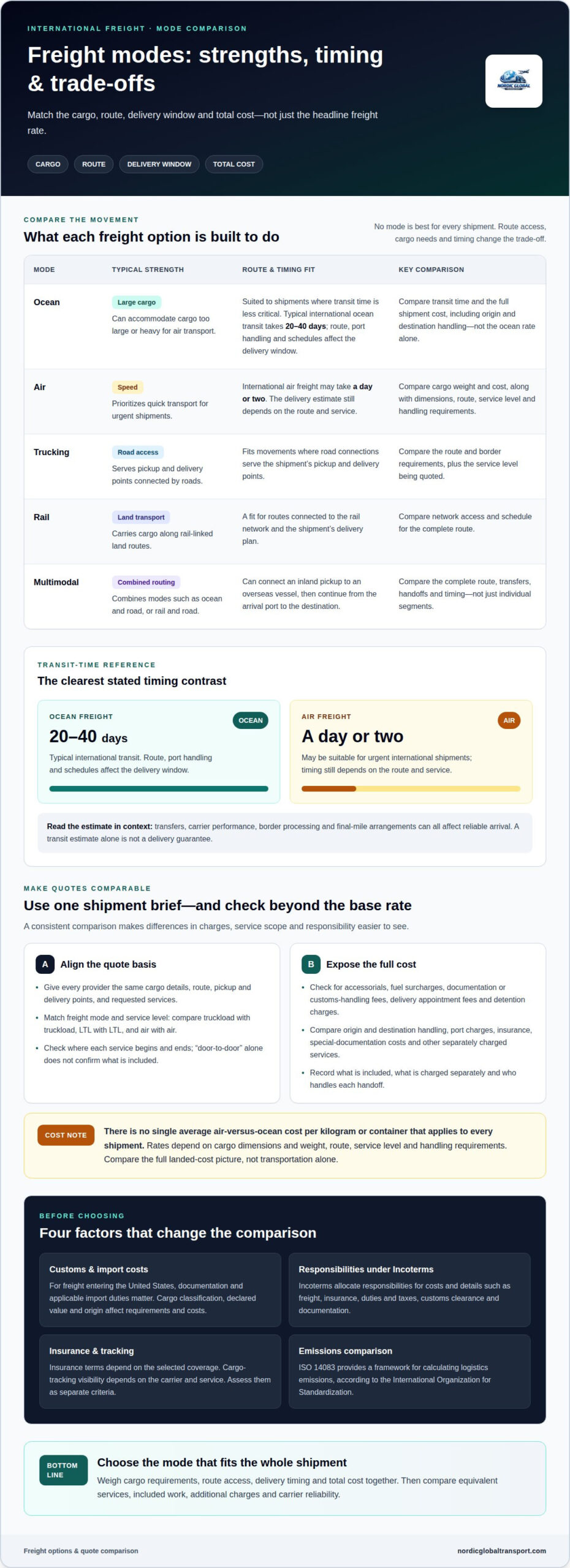
The right freight option depends on the balance between delivery speed, total cost, route, and cargo needs. To compare international freight options, start with the trade-off: ocean freight is suited to shipments where time is less critical, while air freight prioritizes speed. International ocean transit typically takes 20-40 days, while air freight may take a day or two. Rail, trucking, and multimodal freight can fit routes and delivery plans that call for a different combination of speed and transport modes.
Cost alone doesn’t show which option offers the best value. Compare quotes using the same shipment details, route, pickup and delivery points, and requested services, then account for charges beyond the freight rate. Transit estimates, reliability, customs requirements, and included services also affect the decision. This guide explains how ocean, air, rail, road, and multimodal freight differ, what to assess when comparing quotes, and how to choose an option that fits your shipment’s priorities.
Key Takeaways
- Match the freight mode to your cargo, route, delivery window, and budget rather than choosing on price alone.
- Compare quotes for the same shipment details and service level, including charges beyond the base freight rate.
- Assess transit estimates alongside carrier performance and route consistency to plan for delivery needs.
- Review rate validity and included services so you can distinguish a current, comparable quote from an incomplete one.
Ocean, air, trucking, rail, and multimodal freight options
To compare international freight options, assess the route, cargo, timing, and total cost together. Each mode suits a different type of movement.
Ocean Freight
Ocean freight moves international cargo by vessel and suits shipments where transit time is less critical. Typical transit takes 20-40 days, though route, port handling, and schedules affect the delivery window. It can accommodate cargo that is too large or heavy for air transport. Compare the full shipment cost, including origin and destination handling, rather than the ocean rate alone. A container shipment and a time-sensitive replacement part have different priorities.
Multimodal Freight
Multimodal freight combines transport modes, such as ocean and road or rail and road, along one shipment route. It can connect an inland pickup with an overseas vessel and continue from the arrival port to the final destination. The trade-off is coordinating changes between modes, which can affect handoffs and timing. Compare the complete route and delivery plan, not just individual segments. Multimodal transport can combine the advantages of different modes when one cannot efficiently serve the entire journey.
| Option | Typical strength | Key comparison |
|---|---|---|
| Ocean | Large cargo | Transit time |
| Air | Speed | Weight and cost |
| Trucking | Road access | Route and border |
| Rail | Land transport | Network and schedule |
| Multimodal | Combined routing | Transfers and timing |
Choose a mode that suits the cargo and route while meeting the required delivery window.
Air freight may take a day or two for international transport, making it suitable for urgent shipments. Road freight serves pickup and delivery points connected by roads, while rail can carry cargo along rail-linked land routes. When businesses compare international freight options, they weigh route access, transfers, delivery timing, and cargo requirements.
Insurance terms depend on the selected coverage, and cargo-tracking visibility depends on the carrier and service. Assess both as separate comparison criteria.
For freight entering the United States, customs clearance involves shipment documentation and applicable import duties. Cargo classification, declared value, and origin affect the requirements and costs.
There is no single average air-versus-ocean cost per kilogram or container that applies to every shipment. Rates depend on cargo dimensions and weight, route, service level, and handling requirements.
Incoterms allocate responsibilities between parties for costs and details such as freight, insurance, duties and taxes, customs clearance, and documentation.
For emissions comparisons, ISO 14083 provides a framework for calculating logistics emissions, according to the International Organization for Standardization.
Air, ocean, and landed-cost calculators require shipment dimensions, weight, origin, and destination. A landed-cost estimate should include freight and relevant import charges, not just transportation.
Comparing international shipping companies, costs, and services
Base each comparison on the same shipment brief, requested service, and delivery scope. This makes differences in charges and responsibilities easier to identify.
Quote Matching by Mode and Service Level
Match quotes by freight mode and service level: compare truckload with truckload, LTL with LTL, and air with air. Give every forwarder the same cargo details, route, pickup and delivery points, and requested services. Quotes for different freight modes may reflect different services and are not directly comparable. Align the service first, then review the charges.
Transport Endpoints and Service Scope
Compare where each service begins and ends. One quote may include pickup, port handling, and final delivery; another may cover transportation only. A “door-to-door” description alone doesn’t establish whether customs, duties, taxes, or insurance are included. List each endpoint and requested service, then compare them with the scope stated in the quote. This reveals gaps a headline rate can hide.
Freight forwarders can coordinate cargo space and help estimate freight costs, port charges, consular fees, special-documentation costs, insurance costs, and handling fees. They may also prepare bills of lading and other shipping documents or coordinate with customs brokers overseas. Compare which tasks are included, which are charged separately, and who handles each handoff.
To compare forwarders and get accurate quotes, provide each with the same shipment details, route, pickup and delivery points, and requested services. Compare the same service level and review every charge beyond the base rate. Look for accessorials, fuel surcharges, documentation or customs-handling fees, delivery appointment fees, and detention charges. Ask how claims are processed, who communicates about disruptions, and what backup routes are available.
For a practical comparison, record the mode, endpoints, included services, additional charges, and responsible party in one table. This keeps differences visible without assuming that similarly named services cover the same work. A consistent brief also supports planning for international freight services.
Transit times and carrier reliability
Transit planning compares expected movement with reliable arrival, not just the fastest advertised estimate. Route, carrier performance, transfers, and border processing all affect delivery timing.
Transit Schedules and Delivery Timing
A transit schedule sets expected movement between pickup and destination, but delivery timing also depends on handoffs and final-mile arrangements. Air freight may take a day or two internationally, and air carriers typically operate multiple flights per day. That frequency can help limit delays when a flight falls behind schedule. Some standard guaranteed freight services offer delivery within a one-hour window, a narrower commitment than a general transit estimate.
Transit Time Comparisons
Compare modes using shipment-specific timing, then consider how much schedule variation matters to your inventory plan. Ocean carriers can fall behind schedule by a few days, while air transport may take a day or two internationally. These figures describe different service patterns, not equivalent routes or end-to-end delivery promises. Record pickup, transfer, arrival, and final delivery milestones so the comparison reflects the complete journey.
Carrier Reliability and Freight Risks
Assess carrier performance data, on-time delivery rates, and network consistency alongside quoted transit times. Key risks include schedule changes, cargo damage during handling, and customs holds caused by incomplete documents or processing. Packaging, clear handling labels, and accurate documentation help address different points of exposure. A customs broker may conduct customs business for others, including for shipments moving to Canada.
To manage disruption risk, compare the carrier’s booking status, scheduled milestones, and available backup routes before transit. Ask how the carrier handles missed connections and who will communicate changes. For time-sensitive inventory, compare the delivery date with when the stock is needed, rather than relying on a single arrival estimate. A longer planned window can provide room to respond when ocean schedules shift by a few days.
Comparing freight rates from multiple providers
A rate comparison is useful only when every offer applies to the same shipment and timing. Check validity dates alongside total charges, service scope, and the event each price covers.
Freight rates can change, so an expired offer isn’t a reliable basis for comparison with a current quote. Request an updated quote using the same shipment brief, then confirm the rate’s validity date and applicable booking or shipping event. This prevents a current offer from being judged against an outdated figure. It also clarifies whether the quoted amount applies to a specific departure or another milestone.
A hypothetical comparison for the same 20-foot FCL shipment illustrates why the base ocean rate alone can mislead. Quote A has a lower base ocean rate, while Quote B has lower stated charges overall. Differences in destination handling and final delivery contribute to the totals. Compare each listed component and the complete amount, rather than treating the lowest base rate as the least expensive logistics choice.
- Match the shipment, route, and service level across each offer before comparing totals.
- Record the quote date, validity period, and event to which its rate applies.
- Separate the base freight rate from handling, pickup, and final delivery charges.
- Compare documentation, customs handling, and cargo-tracking arrangements as part of service scope.
Use one comparison sheet to capture each provider’s rate basis, stated charges, included services, and timing conditions. If an offer has expired, replace it with an updated quote based on the same shipment brief. This gives your team a like-for-like basis for selecting an option, while making cost and service differences visible. Request a freight quote for your shipment details.
NORDIC GLOBAL TRANSPORT: Road Freight
NORDIC GLOBAL TRANSPORT provides Road Freight for businesses moving cargo along road-connected routes. It also offers Air Freight, Sea Freight, and Rail Freight, giving businesses transport modes to compare against shipment timing, route, and cargo requirements. Road Freight may suit shipments with road-accessible pickup and delivery points or form part of a longer journey.
Use the criteria in this guide to define your shipment requirements: origin, destination, delivery window, and requested service scope. NORDIC GLOBAL TRANSPORT can help businesses match these needs to its freight services. For road-based cargo movements, outline the route and delivery requirements.
Contact NORDIC GLOBAL TRANSPORT to discuss your freight requirements, or visit nordicglobaltransport.com.
Plan the Next Shipment with Confidence
Turn your freight comparison into a shipment plan that supports purchasing, production, and delivery priorities. As you compare international freight options, define what matters most for this movement: cargo requirements, route, receiving schedule, and the responsibilities each party will manage. A clear brief gives your logistics team a practical basis for coordinating the next step.
NORDIC GLOBAL TRANSPORT offers Road Freight, Air Freight, and Sea Freight for business shipments. The right service depends on the movement you need to arrange and your cargo priorities. Share your requirements to discuss a suitable freight approach while keeping timing, cost structure, and operational needs in view.
Contact NORDIC GLOBAL TRANSPORT for freight help and move your shipment planning forward with clarity.
Frequently Asked Questions
What are the main international freight options: air, ocean, rail, and road?
The main options are air, ocean, rail, and road freight, while multimodal transport combines modes for one shipment. Air suits time-sensitive cargo; ocean can carry international shipments when speed is less critical. Rail serves land routes with rail connections, while road freight links origins and destinations accessible by road. For example, cargo might travel by ocean to a port, then continue inland by road.
How do international freight options compare in transit time?
Air is generally the fastest mode, while ocean typically takes longer; rail and road timing depends on the route and connections. Compare the full journey, not just the time between departure and arrival terminals. Pickup scheduling, transfer points, customs processing, and final delivery can all affect when goods reach the receiving site. Request milestone dates, such as collection, departure, arrival, and delivery, to support inventory planning.
When should businesses choose air freight, sea freight, rail freight, or multimodal shipping?
Choose air when the delivery window is the priority and the shipment’s size and handling needs suit air transport. Sea freight may suit larger, less time-sensitive cargo. Rail fits routes with useful rail connections and schedules. Multimodal shipping can bridge gaps between networks, such as moving cargo by road to a rail terminal. Compare the complete route with the required arrival date and receiving arrangements.
How do shipment size, weight, and cargo type affect the best freight option?
Shipment dimensions and weight affect which modes can accommodate cargo and how transport charges are calculated. A bulky load may use available space differently from a compact, heavy load. Cargo type matters too: fragile items may need careful handling, while temperature-sensitive goods need suitable transport conditions. Provide accurate measurements, weight, packaging details, and handling requirements so the proposed route and service fit the shipment.
What extra charges apply to international freight, such as fuel, port, handling, and customs fees?
Possible charges beyond the freight rate include fuel surcharges, pickup, origin and destination handling, port charges, documentation, customs handling, delivery appointments, and detention. Applicable charges depend on the route, service scope, cargo, and time spent at facilities. Duties and taxes are separate import costs, not part of a carrier’s freight charge. Review each quote’s itemized charges and stated inclusions before comparing totals.
What Incoterms affect international freight costs and responsibilities?
Incoterms allocate responsibilities between parties for freight, insurance, duties and taxes, customs clearance, and documentation.