

A full truck isn’t automatically the better choice. Knowing how to choose freight transport starts with matching shipment size and delivery flexibility to the route: LTL combines your freight with other shipments, while FTL reserves the truck for your cargo and moves it directly. LTL can reduce costs, but multiple stops and terminals may extend transit time.
Choosing between LTL and FTL can affect both shipping costs and delivery schedules. This guide shows how to compare them, match road, air, sea, or rail freight to your shipment, and assess carrier compliance and credentials. Use the steps to weigh cargo size, urgency, destination, and handling needs before choosing a transport mode.
Key Takeaways
- Match carrier credentials and handling processes to your freight type, especially for regulated or sensitive cargo.
- Weigh urgency, shipment volume, destination, and delivery flexibility before selecting road, air, sea, or rail transport.
- Understand how domestic, international, and intermodal shipping can shape the route and coordination your shipment needs.
- Compare LTL and FTL against your load requirements, then consider NORDIC GLOBAL TRANSPORT’s road freight for business shipments that fit road transport.
1. Checking carrier compliance and certifications
Start by matching the carrier’s credentials to the freight and route. Requirements vary by freight type and state regulations in the United States, so credentials for general cargo may not cover hazardous materials or temperature-controlled goods. For pharmaceutical shipments, Good Distribution Practice (GDP) guidelines include maintaining detailed temperature records.
For U.S. road freight, review the carrier’s operating authority and safety information. The Federal Motor Carrier Safety Administration issues MC numbers to identify carriers that transport regulated commodities. Safety ratings indicate compliance with federal safety regulations. A safety review can also consider DOT and MC authority status, CSA scores, insurance coverage, and driver qualification standards.
Ownership affects how a shipment is managed. An asset-based carrier owns or directly operates transportation equipment and manages its drivers and fleet operations. A non-asset-based carrier relies on third-party carriers. Ask which party will physically move the freight, coordinate handoffs, and communicate about disruptions. These distinctions matter when a shipment involves multiple carriers or modes.
Understand each provider’s role. A freight carrier physically transports goods using its own or contracted equipment. A broker connects shippers with carriers and may arrange shipments, negotiate rates, and support regulatory compliance. A third-party logistics provider can coordinate transportation, warehousing, and supply chain management between shippers and carriers.
When comparing carriers, brokers, and logistics providers, assess their fit for your freight, service levels, references, and customer reviews. Compare on-time pickup and delivery, claims history, service failures, and communication against your shipment’s priorities. Treat reviews as context and weigh them alongside documented performance measures.
For specialized cargo, examine handling processes as well as credentials. U.S. food and beverage shipments must meet FDA requirements for handling, temperature control, and sanitation under the Food Safety Modernization Act (FSMA). Businesses moving hazardous materials should select carriers with appropriate training and compliance processes. Before booking, record which provider handles each step.
2. Choosing a freight mode based on shipment size, urgency, and destination
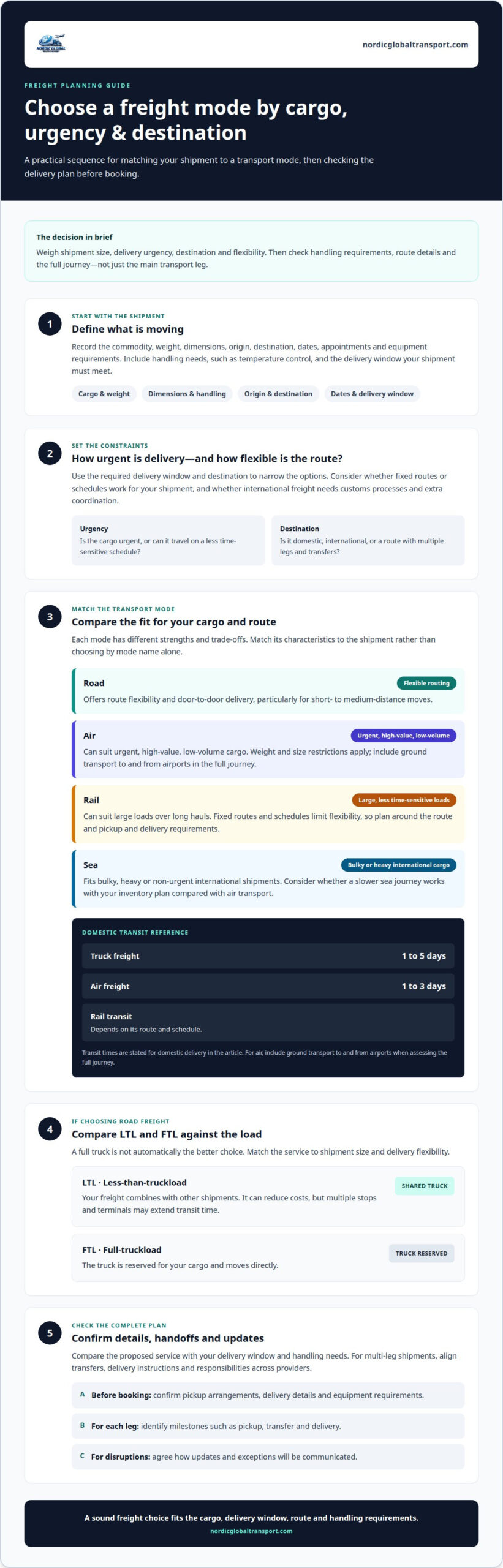
To choose freight transport, weigh shipment size, delivery urgency, destination, and supply chain flexibility. Road freight offers route flexibility and door-to-door delivery, particularly for short- to medium-distance moves. Rail can suit large, less time-sensitive loads over long hauls, although fixed routes and schedules limit flexibility. Air freight suits urgent, high-value, low-volume cargo, but weight and size restrictions apply. Sea freight fits bulky, heavy, or non-urgent international shipments.
For domestic delivery, truck freight usually takes 1 to 5 days, while air freight typically takes 1 to 3 days. Rail transit depends on its route and schedule, so plan around pickup and delivery requirements. Include ground transport to and from airports when assessing air freight’s full journey.
Match the service to the cargo. Check shipment weight, dimensions, handling needs, and delivery window before selecting equipment or a mode. Palletized packaged goods may travel in an enclosed truck, while temperature-sensitive freight needs appropriate temperature control. For international cargo, decide whether a slower sea journey fits your inventory plan better than air transport.
If you’re deciding how to choose freight transport, start by preparing complete details for a quote: commodity, weight, origin, destination, dates, appointments, and equipment requirements. Compare the proposed service with your delivery window and handling needs. Before booking, confirm pickup arrangements, delivery details, and how updates or disruptions will be communicated.
Set visibility expectations when booking. Identify milestones such as pickup, transfer, and delivery, then agree how exceptions will be reported. This gives your team a clear response plan if a delay affects production or customer commitments.
For shipments involving several legs, compare freight mode options against the route, cargo, and required delivery window.
3. What Is Freight Shipping?
Freight shipping moves commercial goods between businesses, warehouses, and customers. Carriers physically transport cargo by truck, air, sea, or rail. A shipment may be a pallet, a package, or a full truckload. Carriers commonly consider shipments over 150 pounds to be freight. The right route depends on the origin, destination, cargo, and delivery requirements.
Domestic freight moves within one country, while international freight crosses borders and involves customs processes. For a U.S.-Canada shipment, consider cross-border operating authority, customs expertise, and documentation support. These needs affect route planning and handoffs. Sensitive cargo may also need handling instructions that remain clear throughout the journey.
U.S. regulations, permits, and documents depend on the freight type, state, and route. First identify the commodity, origin, destination, and equipment, then match the required credentials and paperwork to the shipment. For cross-border freight, customs brokers assist with clearance and customs compliance; documentation needs depend on the countries and goods involved.
International shipments can require coordination among carriers, freight forwarders, and customs brokers. A freight forwarder may specialize in international shipping and handle documentation and customs clearance. Keep shipment details consistent across documents and transport arrangements, especially when cargo transfers between companies or modes.
Rail freight suits large volumes that are not time-sensitive. Intermodal transportation combines two or more modes, such as rail for the longest leg and truck for final delivery. This can connect a rail terminal to a warehouse without taking the entire journey by road. Plan each transfer so the trailer, freight, and delivery instructions stay aligned.
For freight insurance and liability, assess cargo value and exposure to loss or damage. Insurance can protect cargo in case of loss or damage, but policy exclusions and limits vary. Compare the stated coverage and exclusions with the specific risks your shipment faces; there is no universal list of excluded risks that applies to every policy.
Before booking, map the route and identify who handles each leg. For example, an international rail-and-truck shipment needs coordinated pickup, border documentation, transfers, and final delivery. Clear responsibilities help keep domestic and international freight moving through the supply chain.
4. Road freight, including FTL and LTL
Road freight works well when pickup and delivery points need direct truck access. It offers route flexibility and door-to-door delivery, particularly for short- to medium-distance shipments. Traffic, weather, and road maintenance can cause delays, so build flexibility into the schedule. Select equipment based on cargo dimensions, handling needs, and route access.
Less-than-truckload (LTL) combines freight from multiple shippers in one trailer. It can suit shipments from 150 to 15,000 pounds when cargo doesn’t require a dedicated truck. Shared space can reduce costs, but multiple stops and terminal transfers may lengthen transit. Package and secure goods for repeated handling, and provide accurate dimensions to support loading plans.
Full truckload (FTL) reserves the entire truck for one shipment and moves cargo directly from origin to destination. It can suit larger volumes, shipments with tight handling requirements, or cargo that benefits from fewer transfers. FTL is described as most economical at 15,000 pounds or more, while shipments over 26,000 lbs are described as best suited to FTL. These are guidance points, not substitutes for checking the load and route.
Weight also affects planning. According to the Federal Highway Administration, interstate highway weight limits are capped at 80,000 lbs. Cargo weight, equipment, and route restrictions all affect the practical loading plan. Confirm the total shipment weight and equipment fit before dispatch, especially for heavy or oversized freight.
Choose LTL when the load can share trailer space and your schedule allows flexible transit. Choose FTL when the shipment fills a truck, needs a direct trip, or benefits from fewer handoffs. Expedited freight may offer faster transit, but delivery timing can vary. Compare service performance, pickup windows, capacity, and claims experience, not just the base rate.
For business cargo suited to direct road transport, plan your road freight shipment.
NORDIC GLOBAL TRANSPORT: Road Freight
NORDIC GLOBAL TRANSPORT provides Road Freight for businesses moving cargo by truck. Consider this option when the route, shipment volume, and delivery needs make road transport a practical fit. Clear cargo details help align the transport plan with pickup, delivery, and handling requirements.
When road transport alone is not the right fit, NORDIC GLOBAL TRANSPORT also offers Air Freight, Sea Freight, and Rail Freight. Choose a mode according to the cargo, destination, and delivery schedule. These options address different supply chain needs, rather than treating every shipment alike.
Share your shipment requirements with NORDIC GLOBAL TRANSPORT to discuss a suitable freight option. Contact NORDIC GLOBAL TRANSPORT to discuss your shipment.
Build a Clearer Shipping Plan
Use your next shipment to make freight decisions more consistent. Create a shipping profile that records cargo characteristics, destination, handling needs, and delivery priorities. Use it to align logistics decisions across teams and adapt the plan when routes, volumes, or customer requirements change.
A disciplined approach to choosing freight transport turns each shipment decision into a repeatable process. NORDIC GLOBAL TRANSPORT can help businesses assess Road Freight, Air Freight, and Sea Freight in relation to their cargo and route. Share the shipment details and operational priorities that matter most to your business.
Contact NORDIC GLOBAL TRANSPORT to discuss your freight requirements. A clear plan is a practical foundation for moving your business forward.
Frequently Asked Questions
LTL vs FTL: Which Is Better?
Neither option is universally better; choose according to shipment volume, handling needs, and delivery plan. LTL suits cargo that can share trailer space and a schedule that allows terminal transfers. FTL suits freight needing a dedicated trip or fewer handoffs. For example, consider whether your receiving team can accept separate arrivals or needs the full load together.
What Is Freight Shipping?
Freight shipping is the planned movement of commercial cargo from origin to receiver, including transport coordination and delivery handoff. The receiving process matters: palletized stock may need a dock appointment, while machinery may require a specific unloading plan. Include these details in the shipping instructions so arrangements suit the receiving site and the cargo’s handling needs.
What’s the right type of freight company for my needs?
Choose based on how much coordination your shipment requires. A freight carrier physically moves cargo; a broker arranges a carrier match; a third-party logistics provider can coordinate broader activities, including transportation and warehousing. Coordinated logistics can simplify handoffs for multi-leg shipments. For a straightforward load, focus on transport responsibility, shipment communication, and how the provider’s role fits your operation.
What freight transport modes are available, and how do they compare on cost, speed, and capacity?
Truck, rail, air, and ocean freight serve different priorities, while intermodal combines modes within one shipment. Air prioritizes speed and often costs more than road or sea. Sea suits bulky international loads with flexible schedules. Rail can be economical for long-haul volumes, while trucks offer route flexibility. Compare capacity, urgency, and pickup-to-delivery connections together.
How do I choose between truck, rail, air, ocean, and intermodal freight?
Start with your shipment’s most restrictive requirement: handling, delivery timing, or destination access. Choose truck transport when flexible road access matters; consider rail for long-haul volume with schedule flexibility. Air suits urgent, low-volume cargo, while ocean fits bulky international freight with a longer planning window. Intermodal can connect a rail or ocean leg with truck transport to reach the final destination.
What factors affect freight shipping rates in the United States?
U.S. freight rates depend on dimensions, weight, distance, fuel costs, equipment needs, capacity conditions, and service level. Oversized cargo can require different equipment than compact freight of similar weight. Pickup constraints and route requirements also shape the transport plan. Shipment-specific pricing depends on the details provided in a quote request.